
Tea Research Desk: 5 Reasons More Coffee Won't Fix Your Morning
Still reaching for another refill when you want to feel more present? Meet the $19.95 black tea chai with lion's mane, warming spices, and a reason to rethink what belongs in your morning mug.


The frost on my kitchen window was still melting when my sister called about the chai. Outside, Ohio looked frozen; inside, Aunt Rose had left the chai on the windowsill.
"Did Rose leave you something beside the window?" my sister asked. I looked past the kettle and found the package. My usual coffee mug was already waiting on the counter.
*Another refill?* I had been reaching for it before breakfast was even on the table. You may know that small, automatic movement yourself.
Then I noticed the name: Kubo Lion's Mane Chai. "A mushroom in chai?" I asked. My sister laughed. "Read the rest of the label, Della."
For this illustrative kitchen story, picture me pulling out a chair instead of reaching straight for the coffee pot. The product details and research below come from the supplied records.
I wanted a different beginning.
The refill could wait.
You know how it goes. A stronger cup, a larger mug, another pour before you have decided what you actually want from the morning.
*What if I chose the cup first, then gave breakfast a little room?* That seemed like something I could actually try.
That is the alternative I want to explore with you: a different first-cup routine, built around bold black tea chai and an ingredient that has drawn research interest.
Lion's mane mushroom.
Before you picture an earthy drink you have to talk yourself into swallowing, let me tell you what else was on that label.
Cinnamon. Cardamom. Clove. A bright touch of orange peel. This is *chai*: the kind of spice description that makes you look back toward the kettle.
The package is listed at $19.95. Its approximately 155 mg of caffeine per cup belongs near the start of our conversation. This is a caffeinated alternative to coffee, and you deserve that detail upfront.
The appeal is the blend and a more deliberate routine. Tea cannot promise to retrieve a missing name or change your thinking after breakfast. I was choosing something to brew, with the label in front of me.
Before I Reached for the Coffee Pot Again

If you recognize that automatic reach for the coffee pot, pull up a chair. My sister and I had more to talk about than a new flavor.
MILLIONS of Americans think about staying mentally active as they get older. A CDC analysis of 2015–2016 survey data found that 11.2% of adults age 45 and older reported more frequent or worsening confusion or memory loss over the preceding year.
That is a historical survey figure about reported experiences. It does not mean that an occasional misplaced key belongs in the same category, or that a drink addresses those concerns.
For persistent or worsening changes, speak with a qualified healthcare professional. For the everyday question of what to pour at breakfast... there is room for a practical choice.
And this is where the usual coffee conversation gets interesting.
Some studies examine combinations. Some examine timing. Others look beyond caffeine altogether, at ingredients such as *Hericium erinaceus*, the scientific name for lion's mane.
"What are you asking your cup to do?" my sister asked. I had to stop and think. You might find your own answer changes when you put it that plainly.
Help you enjoy breakfast? Fit your caffeine preferences? Offer a familiar flavor with a different ingredient profile? Become a cue for a quieter, more intentional start?
Ask before the second refill.
"Choose the cup you want to sit down with," Aunt Rose said. I kept coming back to that line.
Let's look at five reasons the automatic refill can fall short... then at a chai that gives you another option.
5 Reasons I Stopped Letting the Refill Decide

Coffee can be enjoyable. Caffeine can support alertness. Neither point makes an unlimited refill habit the right answer to a scattered morning.
These five problems concern the approach of automatically adding more. They are not findings that all coffee drinkers should switch to this product.
Read them with your own routine in mind. Which one sounds most familiar at your kitchen table?
1. MORE Caffeine Is a Quantity — Not a Complete Plan
A bigger number can feel reassuring. More ounces. More scoops. More strength on the label.
"Read the number with the rest of your day in mind," I told my sister. You may have another tea or coffee planned already.
The FDA cites 400 mg of caffeine per day as an amount generally not associated with negative effects for most healthy adults. It also emphasizes that individual sensitivity varies. That figure is a general reference, not a daily target. [1]
Your breakfast cup does not exist in isolation. There may be coffee later, another tea, a soft drink, or another source you weren't counting.
And a larger mug makes it easier to lose track of what “one cup” actually means in your house.
Kubo's listed 155 mg per cup makes that conversation concrete. One cup is approximately 155 mg; two would total approximately 310 mg, before any other caffeine.
That arithmetic is useful for planning. It does not establish a recommended number of cups for you.
If your reason for changing drinks is to reduce caffeine substantially, this particular chai may not fit. Choose it for the blend and flavor when its caffeine level suits you.
A deliberate choice starts with that kind of clarity.
You deserve to know what is going into the mug before you decide what you hope to get out of the morning.
2. An Afternoon Rescue Cup Can Reach Further Into Your Day Than You Intended
You know the pattern: breakfast was rushed, lunch felt scattered, and the coffee machine starts looking useful again.
*Another cup now. Think about bedtime later.* I knew that little bargain. Perhaps you do, too.
Timing deserves a place in the decision. In a 2013 study published in the Journal of Clinical Sleep Medicine, a 400 mg caffeine dose disrupted sleep when taken at bedtime, three hours before, or six hours before.
That study used a larger dose than one listed serving of this chai. It does not tell us exactly how you will respond to 155 mg, but it challenges the idea that caffeine matters only while you can feel it.
The commercial takeaway is refreshingly ordinary: put thought into WHEN you drink, along with WHAT you drink.
You are buying a beverage, with the timing considerations that caffeinated beverages bring.
Think about the part of the day you want this cup to occupy. Before your reading? With breakfast? Before you leave for your morning plans?
Then let it have that place.
There is something appealing about giving one cup a clear role instead of asking another refill to patch every dip in the day.
The kettle can mark a beginning. It does not have to become an all-day assignment.
3. Caffeine Alone Isn't the Only Ingredient Researchers Have Examined
The usual choice sounds simple: coffee for energy, tea for something lighter.
"Tea means lighter, doesn't it?" my sister asked. I turned back to the caffeine figure. The label had a more useful answer than that shortcut.
In a 2008 randomized crossover study in Biological Psychology, researchers compared 150 mg caffeine, 250 mg L-theanine, their combination, and placebo. The combination affected several performance measures differently from caffeine alone.
That is ingredient research, not a study of Kubo. Tea naturally contains L-theanine, but the supplied Kubo information does not quantify its amount in a brewed cup. We cannot match this chai to the study doses.
What the study does offer is a reason to look beyond the single word CAFFEINE when learning about tea.
Black tea brings its own character. Spices change the aroma. The mushroom ingredient makes this particular blend different from ordinary black tea.
Those are features you can actually compare while shopping.
You don't have to turn breakfast into a chemistry lesson. You can simply ask whether a different combination sounds more appealing than repeating the same refill.
And you can keep the science where it belongs: a source of context, with the tested amounts and the actual product clearly distinguished.
Interesting ingredients deserve a closer look. They don't need a bigger promise to earn it.
4. A Stronger Brew Doesn't Give You a New Ingredient Profile
Pouring more of the same drink changes the amount. It doesn't automatically change what you've chosen.
If you are interested in lion's mane, the decision involves an ingredient that ordinary coffee does not inherently provide.
A Japanese study published in Biomedical Research in 2019 followed 31 adults over age 50 for 12 weeks. It examined a daily lion's mane preparation, with a positive finding on one mental-status measure, rather than improvements across every test. [2]
The study used a measured mushroom preparation. It did not test chai, coffee, or a kettle routine. Kubo's supplied information does not establish an equivalent mushroom dose.
That boundary matters. So does the simple fact that lion's mane has been studied in people, rather than existing only as a colorful name on a package.
It starts with the species name, continues with the studies, and ends at the actual label of the product you are considering.
A larger ordinary coffee cannot answer that ingredient question. It is still the same beverage in a larger amount.
If what appeals to you is a different blend, choose a different blend deliberately.
That is the invitation here: consider something that changes the contents of the cup, along with the way you begin the morning.
5. “Give Me More” Can Overshadow “What Will I Actually Enjoy?”
Your first cup should be something you want to drink.
Something that makes sense with breakfast. Something whose aroma sounds inviting before you have even picked up the mug.
Yet it is easy to shop by the biggest caffeine number or the loudest promise, then overlook the ordinary details that determine whether a beverage belongs in your cupboard.
For Kubo, there are four concrete flavor notes in the supplied description: cinnamon, cardamom, clove, and orange peel.
There is also a verified customer-review record in the supplied ficha: 44 reviews at the time of capture, with individual comments about taste and choosing an alternative to regular coffee.
What it does give you is a practical window into the buying decision: people notice flavor. They notice package size. They notice whether they want to order again.
Those are worth your attention, too.
A cup that interests you enough to prepare thoughtfully has a different place in the morning from a refill poured because you couldn't think of another option.
Ask a smaller question, with a clearer answer: would I enjoy spiced black tea at breakfast?
If the answer is yes... this is where Kubo becomes worth a closer look.

A Different First Cup... With an Ingredient Worth Knowing

By now, I could explain to my sister what interested me. You can put it just as plainly when someone asks why you are looking at a different tea.
A deliberate morning serving. A flavor you look forward to. An ingredient list you can read. Research context that goes beyond the size of a caffeine number.
You can build that routine once a day without turning it into a complicated program.
And thanks to published human studies, including a 2023 pilot in Nutrients, we can discuss lion's mane using real research details rather than relying entirely on its unusual name. [3]
That does not establish a once-a-day product result. It gives an ingredient-curious shopper something solid to investigate before choosing a tea that contains it.
Breakfast. A chapter. A conversation. Your plan for the morning.
No elaborate stack of products. No imaginary clock ticking toward a new version of yourself.
Just a different beverage decision, made with more information.
Now let's meet the ingredient behind the name... because this story starts somewhere more interesting than a coffee-machine button.
Follow the Ingredient From the Forest... to the Research Table

Picture a pale, shaggy mushroom with long, hanging spines.
No familiar umbrella cap. No ordinary grocery-store silhouette. More like a soft white mane than the mushrooms you would usually slice for dinner.
That distinctive appearance helps explain the common name: LION'S MANE.
Researchers know it as *Hericium erinaceus*. In Japanese research you will also see the name *Yamabushitake*.
Keep those names together as you read. They make it easier to recognize when a study concerns the same species, even when the packaging or the article uses a different common name.
The journey that matters for shoppers is the journey from an interesting food ingredient to a measured research preparation... and finally to a commercial blend.
Each stage asks a different question.
What is the ingredient? What did researchers actually test? What does the product you can buy actually disclose?
I wrote those questions beside the product name. *Keep the ingredient and the finished cup separate*, I reminded myself.
And the Japanese studies are a good place to begin.
In research published in 2009, Mori and colleagues studied 30 Japanese adults ages 50–80, divided into two groups of 15. The intervention lasted 16 weeks, followed by four weeks of observation after intake ended.
The researchers reported group differences at weeks 8, 12, and 16 on their chosen scale. Scores later declined after the intake period ended.
This was a selected research population using a measured preparation, not a general-population test of a chai drink. It cannot establish an outcome for someone buying Kubo.
What makes it relevant here is the ingredient history: lion's mane has appeared in controlled human research over a period of years.
That is a better starting point than assuming the mushroom is either a passing trend or a guaranteed answer.
The story continued. Different researchers used different preparations, different age groups, and different tasks.
Which brings us to the cards below... and to the numbers you should keep attached to the findings.
The Research Numbers... Without the Research Jargon
You do not need to read a stack of journal articles to understand the central point.
An ingredient can be interesting enough to study while the results remain specific to a particular preparation and a particular task.
That is exactly why the details below are useful. They let you see what happened without turning a small trial into an oversized promise.
Thirty-one people. Twelve weeks. A defined daily preparation.
Those are study details you can hold onto. They tell you more than an unsupported phrase like “science-backed brain tea.”
The encouraging part is a specific measured result. The limit is that other tests did not show the same pattern, and the commercial chai has not been shown to reproduce it.
The next paper takes us to a different group and a different research question.
Here the participants were ages 18–45. The specific speed finding appeared about an hour after intake; it did not extend to a general improvement across the testing battery.
You may see this study summarized with much bigger language elsewhere. The narrower description is the useful one.
It is a reason for researchers to keep asking questions. It isn't a timetable for what your breakfast cup will do.
And that distinction leaves plenty to like about the product itself.
You can choose the chai for its black tea, its spice profile, its convenience, and your interest in the mushroom ingredient. None of those reasons requires a claim that the finished blend passed these tests.
What About L-Theanine and Caffeine?
Tea research also offers a useful reminder: ingredients can be studied together, and the measured amounts matter.
The 2008 Haskell study discussed earlier used 250 mg L-theanine with 150 mg caffeine. Some attention and reaction-time measures differed with the combination. The preparation was controlled; the amounts were specified.
In another 2008 study, Owen and colleagues compared 50 mg caffeine, with or without 100 mg L-theanine, against placebo in 27 participants. They assessed performance at 60 and 90 minutes and reported advantages on selected attention measures with the combination.
For the shopper, the accessible lesson is straightforward: “tea” and “coffee” are broad categories. A particular cup deserves to be considered on its own label.
Read the ingredients. Know the caffeine. Enjoy the flavor you choose.
That is a far better buying process than assuming every mushroom drink is alike or every tea is low in caffeine.
Introducing... Kubo Lion's Mane Chai

"So what is actually in the package?" my sister asked. Fair question. I put the research aside and came back to the tea you can buy.
Kubo Lion's Mane Chai brings together bold organic black tea, lion's mane mushroom powder, and warming chai spices in a tea-bag format.
The listed price is $19.95 per package.
The caffeine figure is approximately 155 mg per cup, including caffeine from green tea. Think coffee-level caffeine in a different kind of beverage, with the exact comparison depending on the coffee you usually drink.
And the flavor gives this blend its own reason to exist.
Cinnamon adds a familiar warm note. Cardamom is part of the classic chai character. Clove brings another layer of spice. Orange peel contributes a brighter finish.
Then comes the mushroom ingredient, which gives you something new to learn about without asking you to begin the day with an unfamiliar supplement format.
This is tea in bags. Prepare it as directed on the package.
- - Bold organic black tea with a chai spice profile.
- - Lion's mane mushroom powder listed in the blend.
- - Cinnamon, cardamom, clove, and orange peel.
- - Approximately 155 mg caffeine per cup in the supplied seller information.
- - A tea-bag format that fits a familiar kettle-and-mug routine.
- - $19.95 listed package price before shipping and tax.
What makes that combination appealing is how little ceremony it demands.
You already know what to do with a kettle. You already have a favorite cup. You can decide whether this blend belongs beside breakfast without buying into a complicated lifestyle.
One cupboard choice. One cup prepared according to the label. One opportunity to begin the morning with something you chose on purpose.
The blend is designed to support an enjoyable, intentional morning tea routine.*
*Individual results vary. No finished-product cognitive benefit has been established for Kubo Lion's Mane Chai.
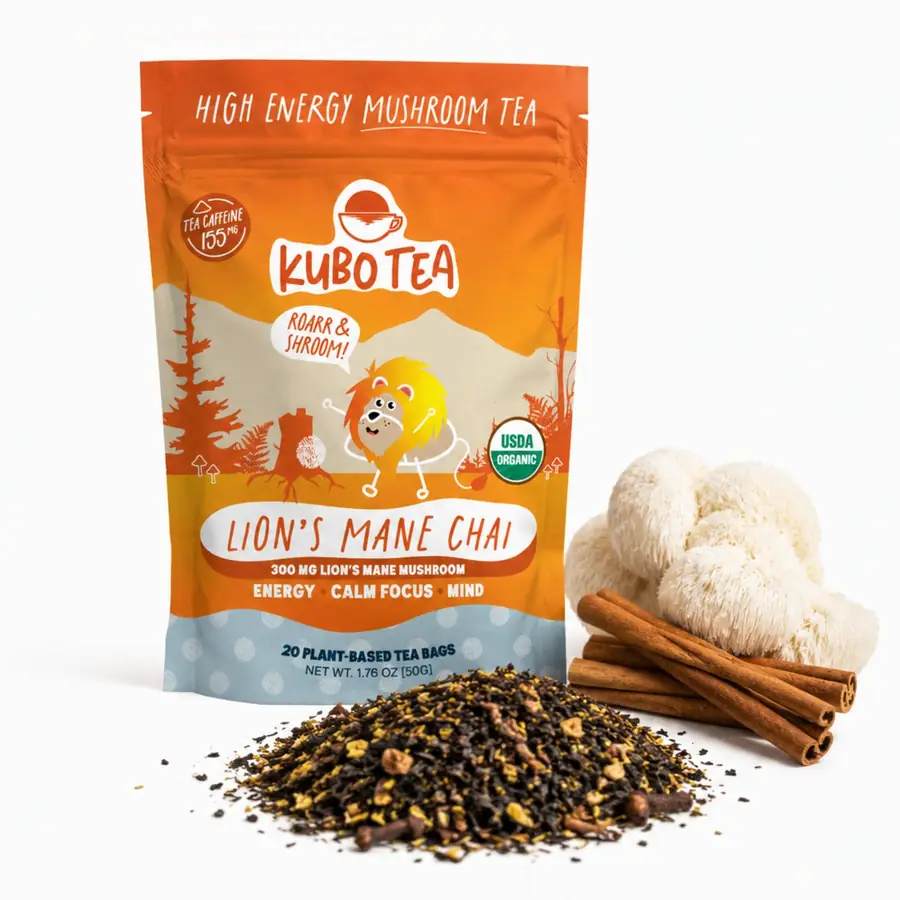
Review the current package, total price, caffeine, and seller guarantee terms.

What People Actually Say About the Cup

The ingredient story gets your attention. The taste decides whether the package earns another place in your cupboard.
So let's move from published papers to a different kind of evidence: the words of people reviewing the tea on the seller's product page.
The supplied ficha records 44 reviews. The quotations below preserve the reviewers' wording exactly, including spelling and punctuation.
Dates shown are our source-capture date, October 31, 2026. The supplied record does not include the original dates on which these customers posted their reviews.
My Friend bought me a bag of Lions Mane chai for my birthday last month and I love it so much! I just purchased a second bag. It's so good!
Kelly Ruby · Review source captured October 31, 2026 · Original posting date not supplied.
Very good tea, from the taste, to the caffeine content. I like this alternative to regular coffee. Ive ordered twice now since coming across
J.Ortiz · Review source captured October 31, 2026 · Original posting date not supplied.
Great taste. Love this brand.
Lora Doll · Review source captured October 31, 2026 · Original posting date not supplied.
Enjoyed the tea just wish it was larger size.
Bobby Q · Review source captured October 31, 2026 · Original posting date not supplied.
*Individual results vary. Customer reviews describe individual experiences and do not establish cognitive benefits or expected results.
There is a useful pattern in these comments.
Flavor. A second purchase. An alternative to regular coffee. A wish for a larger size.
If you have bought an interesting beverage before and found yourself leaving it at the back of the cupboard, you know why this matters.
The most elaborate ingredient story in the world cannot make you look forward to a flavor you don't enjoy.
Here, the real customer language brings the conversation back to tea. The first question is still simple: does this sound like something you would like to brew?
You may be the person who loves chai already. You may be looking for a change from your usual black coffee. Or you may simply want a morning option that feels different enough to make you sit down and notice it.
If any of those describes you, the seller page is worth a visit.
Read the current details. Look at the package. Decide whether you want this blend in your own mug.
Can You Picture Yourself This Time Next Month...?

The kettle is ready. Your favorite mug is where you left it. Breakfast has a place at the table, and the phone can wait until you have taken a few sips.
You have chosen a cup because you enjoy it.
You know its caffeine. You know which spices are in the blend. You know why the words lion's mane caught your attention in the first place.
There is no need to wonder whether you bought ordinary tea under an exciting name. You have read the label and understood the difference between an ingredient study and a study of the finished product.
Now the choice can be ordinary again... in the best sense of the word.
A warm drink. A chair pulled out. A few minutes with one thing in front of you.
Picture reading the first pages of a book because you want to read them, rather than keeping a second screen beside every paragraph.
Picture asking someone how their day is going and letting their answer be the only conversation happening at the table.
The tea doesn't perform those actions for you. You do.
But a beverage you enjoy can give that moment a familiar beginning. It can be the thing you prepare when you decide the next few minutes deserve a little space.
That is the future worth picturing here: a routine you like enough to repeat.
No promise that your keys will stay put. No expectation that every word will arrive on command. Just the satisfaction of making a thoughtful choice instead of pouring another automatic refill.
Maybe the change you want is smaller than the advertising around morning drinks makes it sound.
Something warm. Something spiced. Something you are curious enough to try.
Kubo offers a specific way to explore that possibility. If its caffeine and ingredients fit, you can put the kettle on and decide what you think of the actual cup.
One package. Your own taste. A morning that still belongs to you.

The Blend, Explained in Plain English

You may have seen complicated names attached to drink formulas. Words that make an ordinary shopping decision sound as though it requires an advanced degree.
"Start with what goes into the mug," I said. That made the label easier for both of us to follow.
Kubo's formula combines a tea base, chai spices, a mushroom ingredient, and caffeine from green tea.
There is no validated Kubo-specific “layering” process established in the supplied evidence. The reason to consider the tea is the actual combination in the package.
Without burying you in the science, here is what you need to know about each part.
The Black Tea: A Familiar Foundation
A chai needs a base that can stand alongside its spices.
Black tea gives this blend a recognizable tea identity, which matters if you want an alternative to coffee that still feels like a substantial morning drink.
Think about your own preferences. Do you like a bolder cup? Do you enjoy tea with breakfast? Does a spice-forward blend sound more interesting than your current routine?
The black tea is part of what makes this product a beverage choice. It belongs in a mug, prepared as directed, and judged partly by whether you enjoy drinking it.
If you are already a tea drinker, this is familiar territory with a different blend to explore.
If you usually drink coffee, this is where the change begins: a different base, a different aroma, and a kettle routine instead of another trip to the pot.
The Spices: A Reason to Look Forward to the Cup
Cinnamon. Cardamom. Clove. Orange peel.
Read that list slowly and you can see why this product does not have to depend on a mushroom story alone.
There is warmth in the description. There is a bright note at the finish. There is something recognizable for anyone who already enjoys chai.
The practical benefit of a flavor you like is that you want to return to it. You aren't forcing yourself through an unpleasant drink because you think a wellness routine must feel like work.
That may sound simple. Simple is a useful quality at breakfast.
There are enough things that can become complicated before you leave the house. Choosing a beverage can remain a question of ingredients, taste, caffeine, and cost.
Start with those. Let the aroma be part of the appeal, without asking a spice to carry a promise that hasn't been established.
The Lion's Mane: The Ingredient That Makes You Curious
This is the distinctive ingredient named on the package.
*Hericium erinaceus*. Lion's mane mushroom powder. The same species name you encountered in the research discussion, presented here as part of a tea blend.
For an ingredient-curious reader, that connection can be enough to make the product interesting.
You can ask what is in it. You can read the published research. You can understand why a specific trial does not become a guarantee about a different preparation.
Curiosity is a perfectly reasonable part of a beverage purchase. It doesn't require certainty about an outcome beyond the cup itself.
When you open the current listing, look for the ingredient information that matters to you. If you need more detail about the mushroom amount or preparation, ask the seller before ordering.
An informed question is a good next step. So is choosing a different beverage if the available information doesn't meet your needs.
The Caffeine: Know the Number Before You Pour
Approximately 155 mg per cup.
That figure matters whether the package shows a mushroom, a tea leaf, or a coffee bean.
Kubo's blend includes caffeine from green tea. The source is part of the ingredient story; the amount remains part of your daily caffeine decision.
If your usual morning is built around a caffeinated drink, this may be a different way to enjoy that part of breakfast.
And if you have questions about caffeine alongside medicines, pregnancy, nursing, or your personal circumstances, ask a qualified healthcare professional before changing your routine.
A clear caffeine figure makes the product easier to evaluate. It lets you choose the cup for what it is rather than for an assumption about what tea should contain.
That is the whole formula in plain English: tea, spices, lion's mane, and disclosed caffeine... brought together in a familiar format.
Why the First-Cup Decision Is Worth Making on Purpose
You make dozens of small decisions before lunch.
Which message needs an answer. What to put on the shopping list. Whether to start the laundry now or after breakfast. Where you left the note you meant to bring with you.
Your morning drink can be one decision you make once, then enjoy without reopening the question every ten minutes.
That is part of this chai's appeal.
It has a clear identity: black tea chai with lion's mane. A listed price: $19.95. A disclosed caffeine figure: approximately 155 mg per cup.
You don't need to compare imaginary levels of “brain power.” You can compare the actual features that determine whether you want to buy a beverage.
Then consider the format. Tea bags may fit your kitchen better than loose ingredients, a frother, or a new countertop appliance.
Next, consider caffeine. This is a meaningful amount, so count it alongside the rest of your day rather than reading it as an incidental detail.
Finally, consider what you want the routine to feel like. A cup at the table? Tea with breakfast before you head out? A warm drink beside the first chapter of your book?
Those are choices you can make immediately. They don't depend on a promise about what might happen weeks later.
The product gives you a particular cup to consider. Your own preferences tell you whether that cup belongs in the morning you want.
For the Reader Who Is Tired of the Same Old Refill
Sometimes you aren't looking for more. You're looking for DIFFERENT.
Different flavor. Different aroma. A different reason to stop beside the kettle before the day gets busy.
That is a sensible reason to look at Kubo.
You can keep your favorite mug. Keep breakfast where it is. Keep the parts of your morning that already work for you.
The decision can be as small as changing what you put in the cup.
And if that small change makes the routine more enjoyable for you, it has earned its place without needing to become a grand personal project.
For the Tea Drinker Who Wants Something With More Character
Perhaps coffee isn't the starting point at all.
Perhaps you already have a kettle you love and a shelf of teas that all begin to feel a little familiar.
A chai with a mushroom ingredient offers another blend to consider, with a flavor profile that gives you more to evaluate than the name on the box.
Then ask the tea-drinker's most useful question: would I like to brew this tomorrow morning?
That question keeps the choice grounded in the cup you will actually drink.
The research story can make an ingredient interesting. Your own enjoyment decides whether the tea becomes part of the cupboard.
For the Shopper Who Reads Labels Before Headlines
I was interested. My sister still had questions. If you are holding both thoughts at once, you are in good company at this kitchen table.
Good. A specific question is much more useful than a vague feeling that a product sounds impressive.
What is the caffeine per serving? Is the mushroom amount disclosed? What is the package quantity? Which guarantee applies if I buy directly from Kubo?
Kubo Tea LLC is based in San Diego, California. The contact email preserved in the supplied record is [email protected].
If an ingredient detail matters to you and isn't available in the listing, use that contact route before ordering.
A clear answer lets you make the next decision with confidence in the information, rather than confidence borrowed from a headline.
Make the Cup Part of Something You Already Want to Do
Here is a practical way to think about a new morning routine.
Choose something you want to give your attention to. Then decide whether you would enjoy a cup of chai beside it.
The activity comes first.
The tea gives it a pleasant beginning. For me, that meant putting something to read beside the mug before I reached for my phone.
Maybe you want to read the community paper without checking every alert on your phone. Put the paper on the table before you boil the water.
Maybe you want to make tomorrow's shopping list while you can still see what's in the refrigerator. Set the notepad beside breakfast.
Maybe you want to catch up with someone at home before the day pulls you in different directions. Ask them to sit down while the tea is prepared.
These are ordinary actions. You can try them with any suitable drink.
The warm spice description. The black tea base. The lion's mane ingredient. The familiar tea-bag format.
Those features give you a specific option instead of a vague instruction to “improve your morning.”
And specific is easier to picture.
You can picture the mug. You can picture where you would sit. You can decide whether the cup belongs beside breakfast or another suitable morning moment.
You don't need to picture a different personality or a perfect day.
Just the next morning... with a beverage you've chosen on purpose.
Keep the First Try Simple
Read the package directions before brewing. Use the serving and preparation instructions actually supplied with the tea.
Give the flavor your attention. Decide what you think of the spice balance and the black tea character.
If you normally add something to chai, consider your own preferences and dietary needs. Anything you add changes the finished drink.
The first cup is a first impression. It doesn't need to become an experiment with ten moving parts.
You are allowed to like it. You are allowed to prefer something else. You are allowed to decide that its caffeine level doesn't fit the place you wanted to give it.
That is why the actual product details and purchase terms belong next to the excitement about trying a new blend.
Keep the Routine Yours
Some mornings are quiet. Others start with a delivery at the door and three things that need your attention before breakfast.
A useful routine has room for both.
If you choose this tea, let it be an option you enjoy rather than another rule you have to satisfy.
The goal is to make an ordinary part of the morning feel more intentional, without turning every breakfast into a performance review.
That is a modest promise about a routine... and a very practical reason to take a closer look at an appealing tea.
Let's Put the Price Beside the Product
Kubo Lion's Mane Chai is listed at $19.95 per package in the supplied product record.
"The package price first," my sister said. "Then check what checkout adds." That is how I would suggest you read this offer, too.
You are considering a packaged chai blend with black tea, lion's mane, and spices. The seller checkout determines current availability, package details, tax, shipping, and the final total.
There is no need to compare the price with an imaginary collection of unrelated products. The real comparison is with the beverage you would otherwise choose and the amount you are comfortable spending.
If you often buy drinks away from home, you may already have a clear idea of what beverage variety is worth to you. If you brew everything at home, compare this package with the teas you normally buy.
Either way, use the actual quantity on the current listing before calculating a per-cup cost.
A price makes sense only when you know what it includes.
For others, the caffeine or the package details may point to a different choice.
The offer stays straightforward: review one product, read the current terms, and decide whether you want to try the blend.
Kubo Lion's Mane Chai · $19.95 Listed Package Price
If you already know you enjoy chai, the next step is easy to understand.
Open the current listing. Confirm the package and price. Read the guarantee. Choose whether to place an order directly with the seller.
You aren't committing to a theory about every ingredient. You are deciding whether you want to taste a particular tea.
That is a choice you can make with the information in front of you.

A Published Guarantee Gives You Something Concrete to Read
A new tea can sound appealing on a page. The real question is what you think when it reaches your mug.
Kubo publishes a 30-Day Happiness Guarantee for purchases made on KuboTea.com.
According to the policy reviewed for this article, customers who are unhappy can contact Kubo within 30 days of delivery. The seller describes replacement, store credit, or refund options, subject to its terms.
That is a useful purchase detail. It gives you a published route for raising a concern about the product you received.
It is also worth reading the conditions before you order, while the decision is still in front of you.
The policy says original shipping charges are non-refundable. Purchases through other retailers follow the retailer's own policies. Kubo may request an order number and a short explanation.
The guarantee concerns purchase satisfaction. It does not establish a health or cognitive result from drinking the tea.
Kubo's Published 30-Day Happiness Guarantee
For direct purchases on KuboTea.com, the reviewed policy asks customers to contact Kubo within 30 days of delivery if unhappy. Replacement, store credit, or refund options are subject to the seller's current terms.
Original shipping charges are non-refundable. Other retailers apply their own policies. Read the current Happiness Guarantee and refund policy before ordering; contact [email protected] with questions.
I could finally put the product, price, and policy on the table together. "Now I know what I am deciding," I told my sister.
That is the point where a shopping decision becomes easier to make.
Do you like the sound of the flavor? Does the caffeine fit? Are the current package and purchase terms acceptable to you?
If the answer is yes, there is a clear next step.
$19.95 listed price · Direct-purchase 30-day guarantee, current terms apply · Approximately 155 mg caffeine per cup
Before You Choose... A Few Straight Answers
Questions About Your Next Morning Cup
Kubo Lion's Mane Chai is a packaged food tea in tea bags. The blend includes black tea, lion's mane mushroom powder, chai spices, and caffeine from green tea. Prepare it according to the current package directions.
Its listed caffeine content is approximately 155 mg per cup. Coffee varies, but that is a coffee-level amount. Choose another beverage if you need a caffeine-free or substantially lower-caffeine option.
No finished-product cognitive study is established in the supplied record. The research discussed here concerns particular ingredient preparations and measured amounts. It does not establish the same outcomes for this chai.
It helps explain why the ingredient interests shoppers and researchers. The study cards identify the preparation, participant numbers, duration, and limits so you can distinguish an ingredient finding from a product claim.
The supplied product information does not establish an equivalent mushroom dose per cup. Ask the seller if that detail matters to your purchase. Do not assume that different preparations are interchangeable.
The supplied description combines bold black tea with cinnamon, cardamom, clove, and orange peel. Customer quotations above describe individual experiences with taste. Your own preference may differ.
No. October 31, 2026 is the source-capture date used here. The supplied ficha preserves review wording and reviewer names but does not provide their original posting dates.
The supplied product record lists $19.95 per package. Check current quantity, price, shipping, tax, and the final checkout total before purchasing.
Kubo publishes a 30-Day Happiness Guarantee for purchases on KuboTea.com, with contact required within 30 days of delivery under the reviewed policy. Options and conditions are governed by current seller terms; other retailers follow their own policies.
Ask a qualified healthcare professional if you are unsure whether this caffeine level fits your medicines or circumstances. Persistent or worsening changes in thinking also deserve professional attention rather than a beverage-shopping decision.
The supplied record lists [email protected] for Kubo Tea LLC in San Diego, California. Use current seller contact information for product and order questions.
No. You can make space for breakfast, reading, or conversation with any suitable drink. Kubo is the featured option if you want this particular spiced black tea blend in your cup.
What I Would Tell You Across the Kitchen Table
Before you go to the product page, bring the decision back to the morning you actually have.
You don't need the strongest possible drink just because yesterday felt scattered.
You don't need to ignore caffeine timing because the next cup sounds convenient.
You don't need to assume the word caffeine tells you everything worth knowing about a blend.
You don't need to keep choosing the same ingredient profile if you are curious about something different.
And you don't need to forget the most ordinary question of all: will I enjoy drinking this?
They lead to a practical alternative: choose a specific cup, understand what is in it, and give it a place in a routine you enjoy.
For a chai lover, Kubo has a clear invitation.
Black tea. Warming spices. Lion's mane mushroom powder. A familiar tea-bag format. Approximately 155 mg caffeine per cup. A $19.95 listed package price.
No need to imagine a different life before deciding whether you want a different cup.
You can start with the cupboard. The kettle. The mug you already reach for.
And a simple question: would tomorrow morning be a good time to try a chai like this?
Your Next Step Is the Current Seller Listing
If Kubo Lion's Mane Chai sounds like your kind of cup, the button below takes you toward the current seller offer after the publisher's preference flow.
You can review the package, price, ingredients, caffeine, and guarantee before deciding whether to buy.
The appeal is easy to picture: warm spice, black tea, and a different beginning to the morning.
The decision is yours to make with the actual details in front of you.
Put the facts beside the flavor.
Then choose the cup you want beside you tomorrow morning.
Confirm current package details, total cost, and seller policies before ordering.
*Individual results vary. The featured blend is designed to support an enjoyable morning tea routine; ingredient research and customer reviews do not establish cognitive outcomes from this product.
P.S. Still thinking about another coffee refill? Take a moment to compare the actual alternative: spiced black tea, lion's mane, a familiar tea-bag format, and a disclosed caffeine figure. If that sounds appealing, read the current Kubo listing before choosing your next cup.
P.P.S. The research cards concern measured ingredient preparations, not Kubo tea. Review dates identify source capture, not original customer posting. Current seller terms govern purchases and the guarantee.
Sources and Product Information
Ingredient research: Saitsu et al., Biomedical Research, 2019, DOI 10.2220/biomedres.40.125; Docherty et al., Nutrients, 2023, DOI 10.3390/nu15224842. Numbered references link the two research cards to the repository's verified evidence register.
Additional research context: Mori et al., Phytotherapy Research, 2009, DOI 10.1002/ptr.2634; Haskell et al., Biological Psychology, 2008, DOI 10.1016/j.biopsycho.2007.09.008; Owen et al., Nutritional Neuroscience, 2008, DOI 10.1179/147683008X301513; Drake et al., Journal of Clinical Sleep Medicine, 2013, DOI 10.5664/jcsm.3170. These papers do not establish results from the featured tea.
Population context: CDC, MMWR, July 13, 2018, volume 67, pages 753–757, analysis of 2015–2016 data. Caffeine context: FDA, “Spilling the Beans: How Much Caffeine Is Too Much?” The population figure is historical, not a current market-size estimate or a forecast for this product. [1]
Product and review source: wiki/producto-kubo-lions-mane-chai.md, captured October 31, 2026. Additional seller checks: kubotea.com/products/lions-mane-chai; kubotea.com/pages/satisfaction-guarantee; kubotea.com/policies/refund-policy. The live guarantee was reviewed to confirm its 30-day delivery-based window. Seller pages can change; review current terms before ordering.